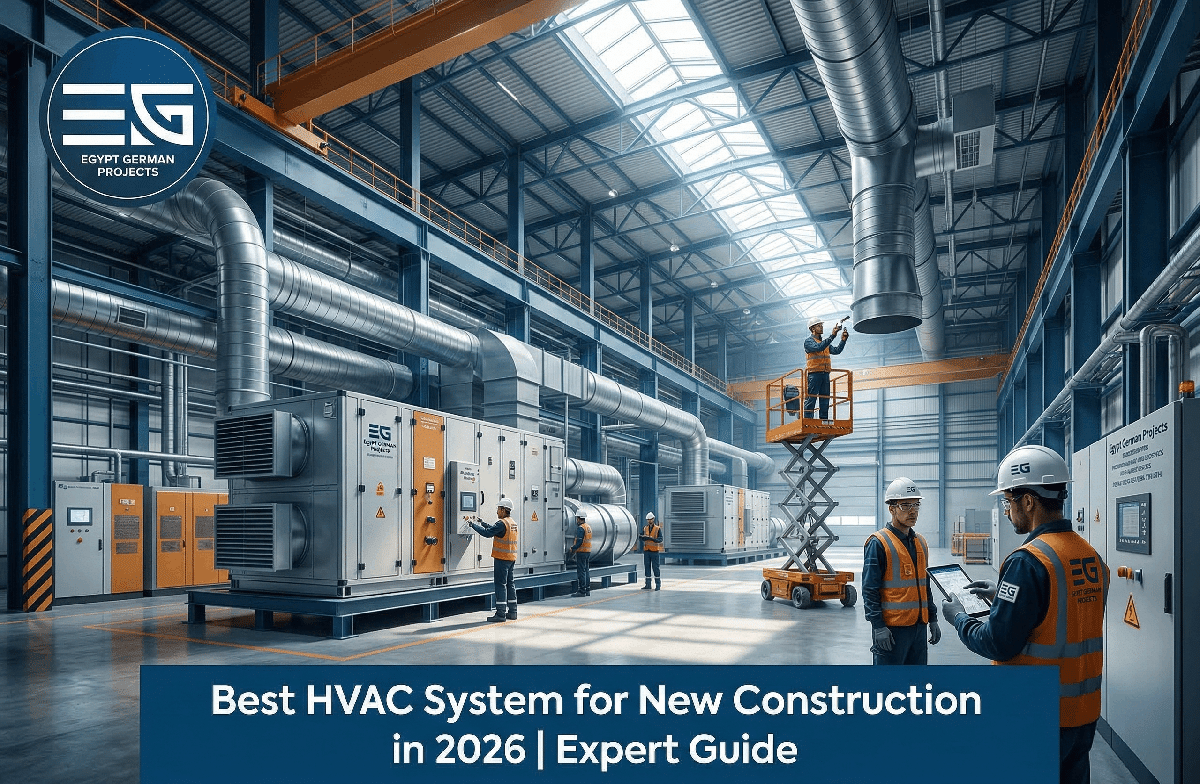
Choosing the right HVAC system is the most important step for a new building’s long-term return on investment (ROI). In Egypt and the MENA region, buildings use about half of all national electricity. Air conditioning alone causes up to 70% of a building’s peak power use. When summer temperatures pass 45°C, poor planning leads to massive energy bills.
Modern commercial buildings need efficient cooling. The best way to save money is an all-in-one approach. This means building Variable Refrigerant Flow (VRF) or Chilled Water systems right into your plumbing and electrical plans from day one.
What Is the Best HVAC System for New Construction?
The best system is custom-built for your project. It must match your building’s specific cooling needs, how it is used, and how many people are inside. It should be planned before you even break ground.
No single system works for every building. Hospitals, factories, office towers, and homes all have very different air, insulation, and maintenance needs.
Why Is HVAC Planning Important Before Construction Starts?
Early planning lowers your starting costs and boosts energy efficiency by up to 35%. It also stops pipes and wires from clashing in the ceiling and keeps the system running well for 15 to 25 years.
When HVAC engineers work directly with architects and plumbers early on, the building runs better. You will face far fewer maintenance headaches later.
Which HVAC System Is Best for Different Building Types?
Different building types require different HVAC solutions because peak cooling loads, occupancy patterns, and continuous ventilation requirements vary significantly.
| Building Type | Recommended HVAC System | Primary Benefit |
|---|---|---|
| Office Buildings | VRF System | Flexible zoning and energy efficiency |
| Hotels | VRF System | Independent room temperature control |
| Hospitals | Chilled Water + AHU | Superior air quality and strict reliability |
| Factories | Chilled Water + Ventilation | Handles massive industrial cooling loads |
| Shopping Malls | Central Chilled Water | Scalable for large, open-area occupancy |
| Residential Complexes | VRF or Central HVAC | Balanced energy efficiency and comfort |
| Airports | Chilled Water System | Continuous operation at maximum scale |

How Do VRF Systems Compare to Chilled Water Systems?
VRF systems offer great room-by-room control and cost less upfront. Chilled water systems are built to last longer. They are better for huge buildings with nonstop, heavy cooling needs.
| Feature | VRF System | Chilled Water System |
|---|---|---|
| Energy Efficiency | Excellent | Excellent |
| Scale Suitability | Good for mid-to-large | Excellent for massive facilities |
| Zone Control | Excellent (Independent) | Moderate (Centralized) |
| Maintenance Need | Moderate | Centralized / Specialized |
| Initial CAPEX | Moderate | Higher |
| Lifecycle OPEX | Low | Very Low |

How Much Does a New Construction HVAC System Cost?
The total cost depends on your building’s size, required cooling power, and smart features. Your upfront installation cost (CAPEX) matters. But your long-term running cost (OPEX) is much more important for your ROI. Spending 20% more on a better system today can slash your energy bills by 40% over its lifetime.
| HVAC System | Initial Cost (CAPEX) | Operating Cost (OPEX) | Best Suited For |
|---|---|---|---|
| VRF System | Medium | Low | Offices, Hotels, Residential |
| Chilled Water | High | Very Low | Hospitals, Airports, Campuses |
| Central HVAC | Medium | Medium | Mixed-Use Retail Buildings |
| Packaged Units | Low | Higher | Small Commercial Spaces |
What Happens If an HVAC System Is Oversized or Undersized?
Both oversizing and undersizing cause critical systemic failures. An oversized system cycles on and off too rapidly, wasting power and failing to remove humidity, while an undersized system runs continuously without ever reaching the target temperature.
Dangers of an Oversized System:
- Short cycling of compressor motors
- Massive spikes in peak electricity consumption
- Poor indoor humidity control (clammy air)
- Shorter overall equipment lifespan
Dangers of an Undersized System:
- Inadequate cooling during peak summer heat
- Constant, 100% load operation causing mechanical stress
- Higher baseline energy bills
- Premature total system failure
Why Does HVAC Load Calculation Matter?
Experts calculate exactly how much cooling your building needs. This prevents you from buying the wrong size equipment. They look at:
- How the sun hits the building.
- Insulation and wall thickness.
- Window types and sizes.
- How many people will be inside.
- Heat from lights and computers.
Why Is Indoor Air Quality (IAQ) Important?
Good air quality is a must for health and comfort. Poor air hurts focus and makes people sick. Modern 2026 HVAC designs use:
- HEPA filters to clean the air.
- Ventilators that pre-cool fresh air to save energy.
- UV lights to kill germs.
- Smart sensors that track CO2 levels.
What HVAC Features Matter Most in Hot Climates Like Egypt?
Answer: In hot-arid climates where the cooling season lasts for 8 to 9 months, HVAC systems must prioritize raw cooling efficiency, dust mitigation, and intelligent automated controls.
Critical 2026 design considerations for the MENA region include:
- Variable-Speed Compressors: Adjusting output smoothly rather than turning fully on or off.
- Predictive AI Controls: Algorithms that pre-cool buildings before peak afternoon heat arrives.
- High-Efficiency Chillers: Built to operate safely even when outdoor ambients hit 50°C.
- Building Automation Systems (BAS): Centralized dashboards to monitor energy bleed in real-time.
What Is the Biggest HVAC Mistake in New Construction?
The biggest HVAC mistake is selecting equipment before completing a professional load calculation and coordinated MEP design.
When HVAC systems are chosen too early, buildings often suffer from oversized or undersized equipment, airflow imbalances, energy waste, costly redesigns, and long-term maintenance problems.
- Incorrect cooling capacity
- Higher operating costs
- MEP coordination conflicts
- Reduced equipment lifespan
- Expensive construction rework
Why Is System Integration So Important?
Even the best HVAC hardware will fail if it doesn’t link perfectly with your electrical and plumbing setups. This is why using one complete team for all engineering works best. It ensures your cooling and ventilation systems run perfectly from day one.
Why Trust Egypt German?
You need an engineering partner with real experience in the MENA region. Egypt German does more than just install units. We have built complete cooling systems for over 50 massive projects across Egypt.
Our core skills include:
- Complete start-to-finish construction and MEP design.
- Advanced HVAC installation and testing.
- Strict matching of global engineering standards.
- Perfect teamwork across architectural and structural designs.
Frequently Asked Questions About HVAC System
Is VRF better than central HVAC?
Yes, for most commercial applications. VRF systems provide superior localized zoning, independent temperature control, and drastically lower energy consumption compared to traditional central ducted systems.
Which HVAC system lasts the longest?
When professionally maintained, heavy-duty industrial chilled water systems generally achieve the longest operational lifespans, frequently exceeding 20 to 25 years.
What HVAC system is best for hospitals?
Hospitals require absolute reliability and sterile air. They typically utilize robust chilled water systems combined with specialized Air Handling Units (AHUs) and multi-stage HEPA filtration to maintain negative pressure and eliminate cross-contamination.
Can modern HVAC reduce overall energy costs?
Absolutely. By implementing variable-speed technology, smart occupancy zoning, and Energy Recovery Ventilators, modern systems can reduce electrical consumption by 30% to 40% compared to legacy setups.
What should be designed first: the HVAC system or the architecture?
Neither should be designed in a vacuum. Both the architectural envelope and the HVAC system must be developed simultaneously through coordinated MEP planning to ensure space, energy, and aesthetic requirements are all met without compromise.