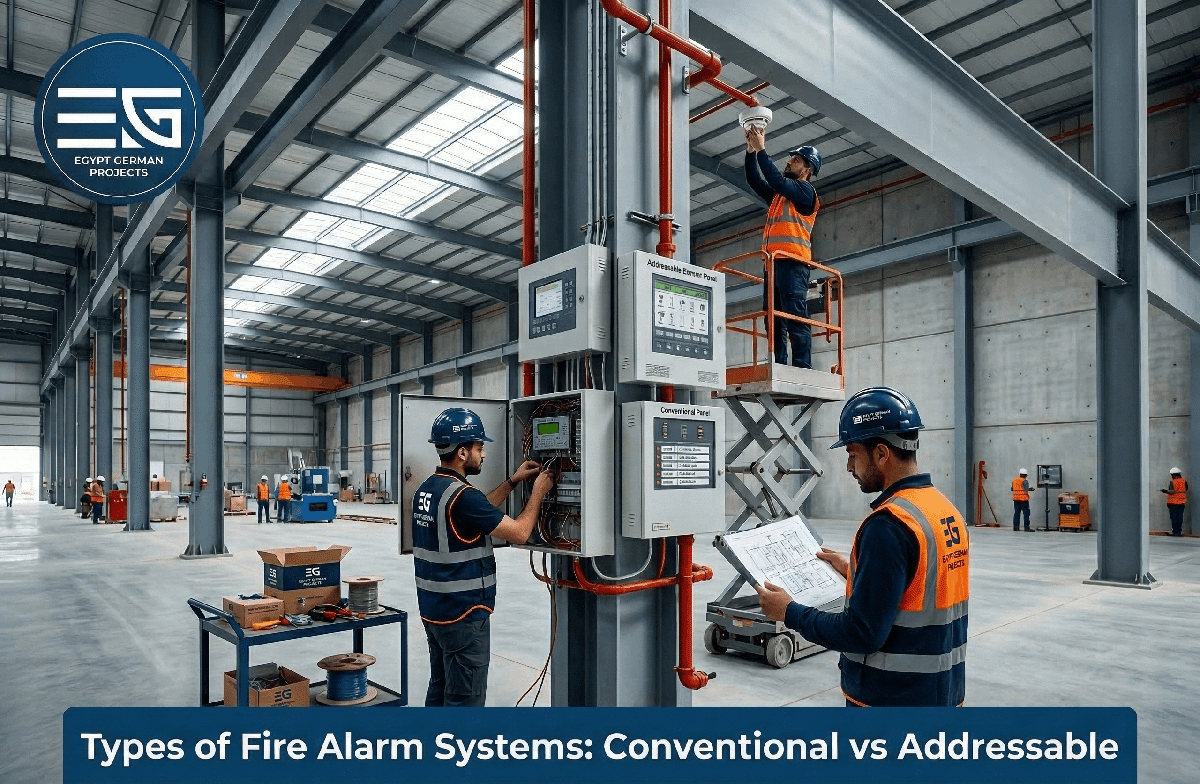
Choosing between conventional and addressable fire alarm systems is the most critical safety decision in any commercial construction project. To achieve strict compliance with the Egyptian Civil Defense regulations and the Egyptian Fire Code, facility managers and contractors must deploy a highly reliable detection infrastructure.
As part of our turnkey MEP (Mechanical, Electrical, and Plumbing) services, the engineering team at Egypt German has broken down the technical differences, wiring architectures, and integration capabilities of these systems to help you protect your commercial assets across Egypt’s premier industrial and corporate hubs.
The Core Types of Fire Alarm Systems
While fire safety technology continuously evolves, modern commercial construction typically utilizes four main classifications of fire detection:
- Conventional fire alarm systems
- Addressable fire alarm systems
- Wireless fire alarm systems
- Hybrid fire alarm systems
For heavy commercial applications—from logistics warehouses in Obour City to high-rise towers in the New Administrative Capital—the industry standard relies heavily on either conventional or addressable fire alarm systems.
What Are Conventional Fire Alarm Systems?
A conventional fire alarm system is the traditional, zone-based detection architecture used primarily in smaller facilities or buildings with simple floor plans.
Engineering Architecture (Zone-Based Detection)
In a conventional setup, the building is physically wired into distinct “zones” (e.g., Zone 1: First Floor Offices, Zone 2: Rear Warehouse).
- Radial Circuits: Each zone requires its own dedicated radial wire connecting the devices directly back to the main Fire Alarm Control Panel (FACP).
- Zone Identification: When a smoke or heat sensor triggers, the FACP identifies the electrical current change on that specific circuit. The panel will display a general alert, such as “Fire Detected: Zone 2.”
- Manual Verification: Because the panel only identifies the circuit, the facility’s safety team must physically search the entire zone to locate the specific room where the fire originated.
Advantages and Limitations
- Advantages: Lower initial hardware costs; simple configuration; highly effective for small retail spaces or single-floor offices.
- Limitations: Slower emergency response times due to manual room-by-room searching; requires significantly more cabling for multi-zone buildings; lacks advanced digital diagnostics for maintenance.
What Are Addressable Fire Alarm Systems?
An addressable fire alarm system is an advanced, microprocessor-based network designed for large-scale commercial, healthcare, and heavy industrial facilities.
Engineering Architecture
Instead of radial zones, addressable networks utilize a continuous Data Communication Link (DCL) loop.
- Unique Digital IP: Every individual device on the loop—whether it is a smoke detector, heat sensor, or manual call point—is assigned a unique digital address (e.g., “Detector 045”).
- Pinpoint Accuracy: When a hazard is detected, the control panel displays the exact location and device type instantly, such as “Smoke Detected – 3rd Floor, Server Room 302.”
- Continuous Polling: The master panel constantly “polls” or communicates with each device to verify its operational status, immediately reporting if a specific sensor is dirty, tampered with, or offline.
Advantages and Limitations
- Advantages: Instant, precise location identification reduces emergency response time; advanced digital diagnostics lower long-term maintenance costs; requires less cabling due to loop architecture.
- Limitations: Higher upfront hardware and programming costs; requires specialized technicians for initial configuration.
Comparison: Conventional vs. Addressable Fire Alarm Systems for Egyptian Commercial Projects
Understanding the technical differences between these systems is crucial for ensuring your facility meets the strict codes of the Egyptian Civil Defense.
| Feature / Architecture | Conventional Fire Alarm Systems | Addressable Fire Alarm Systems |
|---|---|---|
| Detection Precision | Zone-level detection (e.g., “General Floor 2”) | Pinpoint device detection (e.g., “Room 204”) |
| Wiring Infrastructure | Multiple radial circuits back to the main panel | Single continuous loop wiring connecting all devices |
| Ideal Egyptian Facility | Small retail stores, basic workshops | High-rise offices, hospitals, heavy industrial plants |
| System Diagnostics | Manual troubleshooting required | Advanced digital diagnostics from the control panel |
| MEP Integration | Basic relay outputs | Advanced integration with HVAC, Elevators, and BMS |

Integrating Fire Alarms into Turnkey MEP Construction in Egypt
In 2026, isolated safety systems are obsolete. To maximize safety and achieve certifications like the Green Pyramid Rating System (GPRS), the types of fire alarm systems you choose must integrate seamlessly with your building’s overall MEP infrastructure.
At Egypt German, our turnkey engineering approach ensures your fire alarm system actively commands other building systems during an emergency:
- HVAC Integration: Automatically shutting down Air Handling Units (AHUs) to prevent smoke from spreading through ventilation ducts.
- Smoke Evacuation: Triggering specific exhaust fans to clear escape routes.
- Access Control & Elevators: Grounding elevators and unlocking emergency egress doors simultaneously.
Final Verdict: Choosing Your Safety Infrastructure
Selecting the right system comes down to scale and complexity. Conventional fire alarm systems remain a cost-effective, reliable choice for small-footprint buildings. However, for modern, multi-story commercial properties or industrial plants, addressable fire alarm systems are the non-negotiable standard for pinpoint accuracy, rapid response, and seamless MEP integration.
Frequently Asked Questions About Types of Fire Alarm Systems
What are the main types of fire alarm systems?
The two primary types of fire alarm systems used in commercial buildings are conventional (zone-based) systems and addressable (pinpoint digital) systems. Wireless and hybrid systems are also available for specialized architectural applications.
What is the difference between conventional and addressable fire alarm systems?
The main difference is detection precision; conventional systems identify general fire zones, while addressable systems pinpoint the exact room and device. Addressable systems also provide advanced digital diagnostics and easier integration with building management software.
Which fire alarm system is better for large buildings in Egypt?
Addressable fire alarm systems are required for large buildings to ensure rapid emergency response and compliance with the Egyptian Fire Code. Their ability to instantly identify the exact location of a fire saves critical minutes during an evacuation.
Are conventional fire alarm systems still used today?
Yes, conventional systems are still widely installed in small, single-floor facilities like retail shops, small clinics, and basic offices. They offer reliable safety at a lower initial equipment cost.
Why are fire alarm systems considered part of the MEP system?
Fire alarms are classified under MEP (Mechanical, Electrical, and Plumbing) because their electrical wiring must interface directly with mechanical ventilation systems. This integration allows the fire panel to control building airflow and suppress smoke during a crisis.
Can fire alarm systems integrate with HVAC systems?
Yes, modern fire alarms integrate with HVAC systems to control smoke spread during an emergency. At Egypt German, our engineering ensures that the moment a fire is detected, your HVAC system automatically shuts down air supply fans and activates exhaust routes.
Which fire alarm system is more cost-effective?
Conventional systems have lower upfront hardware costs, but addressable systems drastically reduce long-term maintenance costs in large buildings. Addressable panels diagnose faults digitally, eliminating the need for technicians to manually inspect every device in a zone.