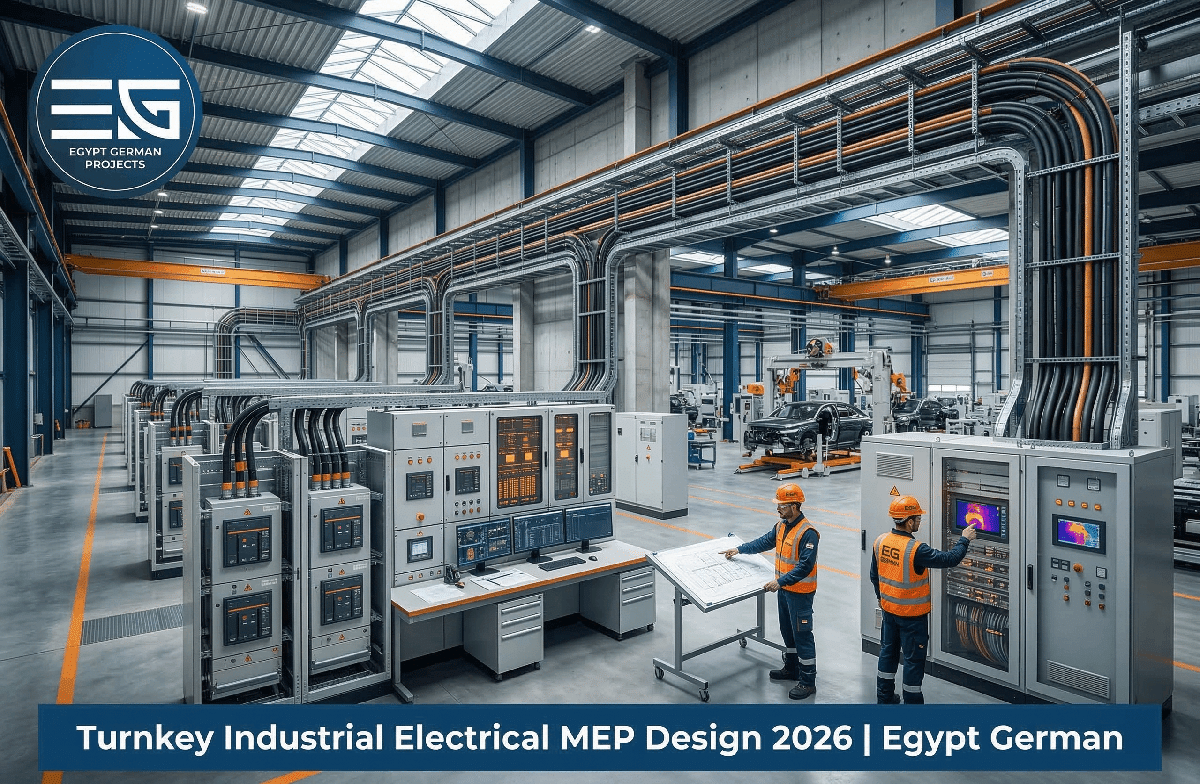
Electrical MEP design is the careful planning of power, lighting, and safety systems inside a building. A good design prevents power overloads, meets safety codes, and lowers your running costs. For industrial projects in Egypt and the MENA region, matching electrical power with mechanical systems is vital to keep factories running nonstop.
What is electrical MEP design in modern construction?
Electrical MEP design maps out all the power, lighting, and backup systems for commercial and industrial buildings.
In MEP (Mechanical, Electrical, and Plumbing) construction, electrical design is the brain of the building. Without a clear plan, heavy equipment cannot run safely. Engineers calculate the maximum power needed before installing any breakers or cables. This ensures the building can handle today’s workload and future upgrades.
How do SLDs, BIM, and Harmonics shape advanced design?
These tools map power flow, prevent construction delays, and protect sensitive equipment.
Modern electrical design uses advanced tools to guarantee safety:
- SLD (Single Line Diagram): The main blueprint of your power system. It maps how power moves from the city grid down to the smallest wall panel.
- BIM (Building Information Modeling): 3D software that models your entire factory. Engineers use BIM to find physical clashes (like a cable hitting an air duct) before building begins.
- Total Harmonic Distortion (THD): Heavy machinery creates dirty power, or “harmonics.” These distortions can fry electronics and overheat transformers. Engineers use active filters to clean the power supply.
What is the difference between high, medium, and low voltage in MEP design?
High voltage handles utility grid transmission, medium voltage feeds large industrial machinery, and low voltage powers standard facility lights and appliances.
Engineers categorize voltage networks strictly to protect personnel and match specific equipment power needs:
- High Voltage (HV): Exceeds 35,000 volts. Used primarily by utility providers to send power across long distances before it hits your site.
- Medium Voltage (MV): Ranges between 1,000 and 35,000 volts. Ideal for massive industrial motors, primary chillers, and large factory substations.
- Low Voltage (LV): Stays under 1,000 volts. This handles your typical facility infrastructure, such as wall outlets and office lights.
What are the main parts of an industrial electrical system?
Industrial spaces need heavy-duty parts to handle massive power shifts safely.
| System Component | Primary Function | Key Metric | Why It Matters |
|---|---|---|---|
| Main Distribution Boards (MDB) | Distributes power to sub-panels | Ampere Interrupting Capacity (AIC) | Ensures safe power distribution |
| Transformers | Convert voltage levels | kVA Rating | Supports industrial equipment loads |
| UPS & Generators | Backup power supply | kVA / Runtime Hours | Prevents production interruptions |
| Grounding Networks | Fault current protection | Ground Resistance (Ω) | Protects workers and equipment |
| PFC Panels | Improve power efficiency | Power Factor (%) | Reduces electricity costs |
Why is electrical MEP design important in Egypt?
Electrical MEP design in Egypt is vital to ensure factories can withstand high summer temperatures, adapt to local grid fluctuations, and support massive industrial expansion.
Operating a factory in Egypt presents unique environmental and logistical challenges. During peak summer months, high ambient temperatures put severe stress on electrical insulation and mechanical cooling systems. A localized, professional MEP design ensures that electrical panels are properly ventilated and that cable sizing accounts for thermal derating.
Top Industrial Cities in Egypt Relying on Strong MEP Systems
Major manufacturing hubs require robust electrical infrastructure to support heavy production. A solid MEP design is the backbone of facilities located in:
- 10th of Ramadan City
- 6th of October City
- Sadat City
- Suez Canal Economic Zone (SCZone)
What are the required electrical approvals in Egypt?
Industrial projects in Egypt must secure specialized electrical approvals from the Egyptian Electricity Holding Company (EEHC), local municipalities, and the Civil Defense authority.
You cannot just plug a factory into the grid. You legally need a compliant MEP design to get your operating licenses:
- EEHC Approval: The Egyptian Electricity Holding Company must approve your load calculations and SLDs.
- Civil Defense: The fire safety authority must approve your emergency lights, fire alarms, and fire-rated cables.
- Industrial Development Authority (IDA): Requires full MEP blueprints before issuing your final factory permit.
How much does electrical MEP design cost in Egypt?
Costs depend on the size of the building, voltage needs, and smart system features.
Electrical engineering costs vary by project. A basic warehouse costs much less than a medical plant with cleanrooms. Your final price depends on:
- The size of transformers and backup generators needed.
- The use of smart energy-tracking software.
- Current market prices for imported gear like copper wire and switchgears.
Case Study: United Company for Pharmacists Warehouse – Port Said
Egypt German completed a full turnkey upgrade of a 4,600 m² pharmaceutical warehouse in Port Said, delivering integrated electrical, HVAC, and fire protection systems to support safe and uninterrupted operations.
Medical logistics facilities require reliable power distribution, stable environmental control, and strict compliance with safety standards. This project included a 4,600 m² steel warehouse and a two-story 500 m² administrative building that required major infrastructure upgrades.
Our Electrical MEP Solution
Our engineering team designed and implemented a complete electrical infrastructure package that included:
- Industrial power distribution systems to support warehouse operations.
- High-efficiency LED lighting networks for storage and logistics areas.
- Electrical integration for HVAC systems to maintain stable storage temperatures.
- Dedicated power supplies for fire alarm and fire-fighting equipment.
- Grounding and protection systems to improve operational safety and equipment reliability.
Project Highlights
| Scope | Details |
|---|---|
| Location | Port Said, Egypt |
| Warehouse Area | 4,600 m² |
| Office Building | 500 m² |
| Fire Water Storage | 600 m³ |
| Services | Electrical MEP, HVAC, Fire Protection |
| Delivery Model | Turnkey |
The project was successfully upgraded through a fully integrated MEP approach, ensuring reliable power, enhanced safety, and long-term operational efficiency for pharmaceutical storage and distribution.
FAQ About Electrical MEP Design
What does MEP stand for in building construction?
MEP stands for Mechanical, Electrical, and Plumbing. It is the comprehensive engineering discipline that transforms raw physical building structures into functional, safe, and inhabitable spaces.
Why is a short-circuit study needed during design phases?
A short-circuit study calculates the maximum fault current your system could experience. It helps engineers select breakers with proper safety ratings to avoid fires or total equipment loss during a power surge.
How does Building Information Modeling (BIM) save money?
BIM finds digital design mistakes before building starts. Fixing a mistake on a computer is much cheaper than tearing down a real wall.
What are the key international safety standards for MEP engineering?
Most projects follow the National Electrical Code (NEC) or the International Electrotechnical Commission (IEC), plus local city rules.
Can a good electrical design lower my factory’s utility bills?
Yes. By designing proper power factor correction systems, implementing LED lighting controls, and balancing industrial loads, a professional MEP design directly reduces monthly energy waste.