Fire risks threaten industrial buildings, factories, and warehouses every single day. A single accident can halt production, destroy critical equipment, and risk lives. To prevent catastrophic losses, every facility requires a robust, locally compliant fire fighting system.
As a top fire fighting contractor in Egypt, Egypt German offers advanced fire system design, engineering, and installation. This is part of our turnkey solutions. With over 15 years of hands-on experience, our engineers safeguard your assets, employees, and business continuity.
Why Egypt German Is Trusted for Industrial Fire Fighting Projects in Egypt
When protecting your industrial facility, you cannot afford to compromise with generic providers. Industrial buildings face exceptionally high fire risks due to continuous operations, heavy electrical machinery, and combustible material storage.
We stand out among fire fighting companies in Egypt because we design for high-risk sites. We ensure full compliance with Egyptian Civil Defense rules and NFPA standards.
Turnkey Fire Fighting & Fire Protection Services in Egypt
Different operational risks require different suppression methods. As leading fire fighting contractors in Egypt, we design systems based strictly on your building layout and specific hazards.
NFPA-Compliant Fire Fighting Systems for Factories & Warehouses
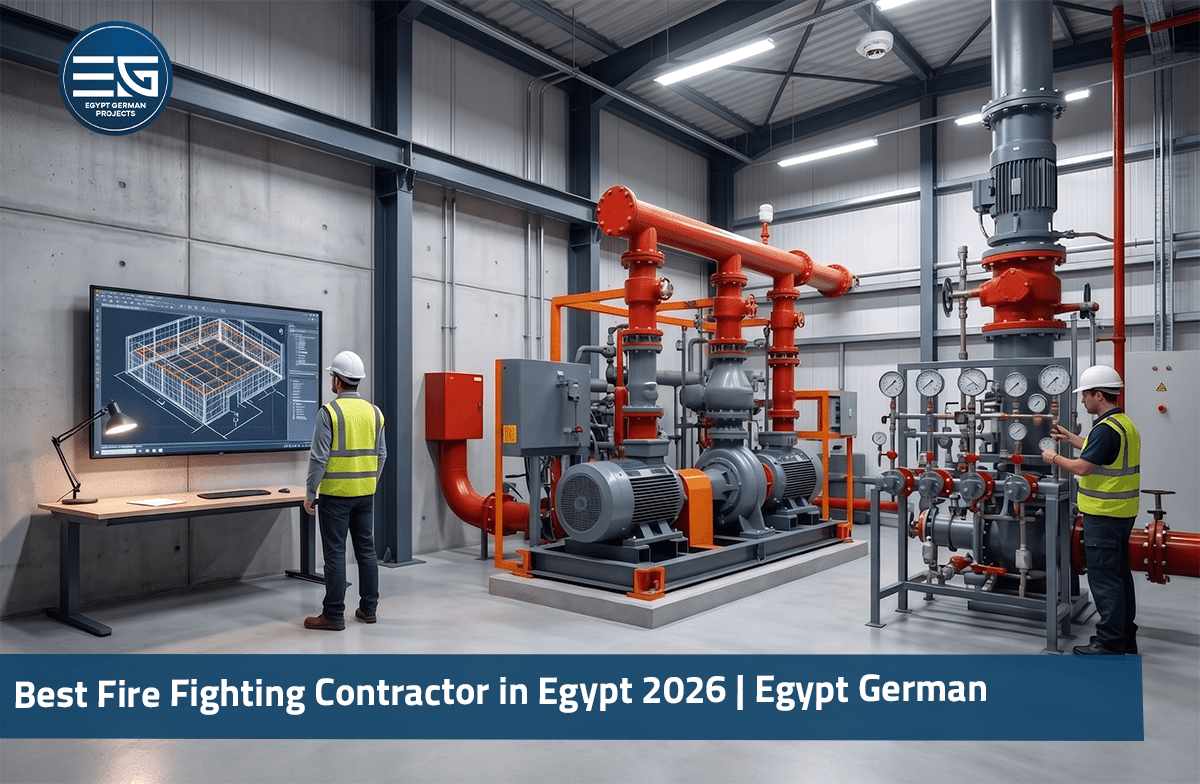
The reliable backbone of warehouse fire protection. We engineer our water-based systems using precision hydraulic calculations to ensure rapid, localized suppression. We install comprehensive networks including:
- High-ceiling sprinkler systems
- Heavy-duty fire hydrants
- Industrial hose reel networks
- High-capacity fire pumps and dedicated water tanks
FM200 & CO2 Fire Suppression Systems for Data Centers & Electrical Rooms
For server rooms, generator enclosures, and sensitive electrical machinery, water causes as much damage as fire. We offer specialized fire fighting services in Egypt for these zones using CO2 systems. By quickly displacing the oxygen a fire needs, CO2 stops flames at once. It leaves no harmful residue on expensive electronics.
High-Expansion Foam Systems for Petrochemical & Fuel Storage
If your facility handles highly combustible liquids, petrochemicals, or fuel storage, traditional systems fall short. Our foam systems quickly create an oxygen-blocking blanket over the hazard. This stops vapor leaks and puts out the fire instantly.
Civil Defense Approved Fire Fighting Systems in Egypt
In Egypt’s industrial sector, fire protection is a strict legal mandate. Failing to meet domestic safety regulations risks facility shutdowns and severe penalties. As an authoritative fire fighting contractor in Egypt, we engineer total operational compliance.
- Egyptian Fire Code: We design every valve, pump, and pipe to pass strict Civil Defense inspections. We ensure your facility is legally clear to operate immediately.
- International NFPA Standards: We boost your safety by following global benchmarks. We use NFPA 13 to design high-capacity sprinkler networks and NFPA 20 to install heavy-duty fire pumps.
MEP-Coordinated Fire Fighting System Design for Industrial Facilities
A fire fighting network must communicate flawlessly with every utility in your building. As a full-service EPC contractor, Egypt German delivers true Turnkey MEP Integration.
- 3D BIM Clash Detection: We utilize advanced 3D Building Information Modeling (BIM) before cutting a single pipe. This ensures our sprinkler networks never clash with heavy electrical trays or HVAC ductwork, saving thousands in redesign costs.
- HVAC Interlocking & Smoke Control: We seamlessly integrate addressable fire alarm panels with your HVAC systems. During a fire, our systems instantly shut down the fans and close the dampers. This cuts off the oxygen supply and traps the toxic smoke.
Industrial Fire Protection Case Study – Al-Awayed Logistics Project
Industrial buyers need proof, not just promises. At Egypt German, our past projects prove our skills. We successfully manage projects in Egypt’s strictest sectors.
Case Study: Al-Awayed Project – Alexandria
- Client: United Company for Pharmacists
- Facility Type: Turnkey Pharma Warehouse & Logistics Hub
- Size: 6,000 m² Warehouse + 2,000 m² Admin Building

The Challenge
Pharma storage needs perfect fire safety. The client needed a massive, standalone fire system. It also had to work inside a climate-controlled space. We had to build this quickly without lowering safety standards.
Egypt German EPC Solution
We acted as the only EPC contractor. This cut out the delays of managing many smaller teams. We combined the civil work, steel structures, and complex MEP safety systems smoothly:
- Custom Fire Buildings: We built a special service building just for fire safety. It holds massive 600 m³ water tanks. This ensures a steady, high-pressure water supply for all fire pipes.
- Smart HVAC Links: Our climate control links directly to the fire panels. If a fire starts, the system shuts down the fans and closes the vents. This blocks oxygen and stops toxic smoke from ruining sensitive inventory.
- Perfect 3D Planning: We managed the whole build, from concrete to the roof panels. Because we controlled everything, we planned perfect 3D pipe routes. As a result, our pipes never block your storage racks.
The Result
We delivered a fully operational, turnkey facility. Because one contractor managed the civil, building, and electrical work, we stopped all delays. The United Company for Pharmacists started their secure, code-compliant work on day one.
EPC Workflow: Our Fire System Design & Installation Process
A system is only as good as its foundational design. Professional fire protection requires rigorous planning to ensure it does not fail during a critical emergency.
- Detailed Risk Assessment: We identify fire hazards, evaluate building layouts, and assess storage materials.
- System Engineering: We map out pump rooms, pipe networks, and suppression zones.
- Turnkey Integration: We seamlessly integrate our fire safety control panels with your existing MEP and HVAC construction.
Long-Term Reliability: Fire System Testing & Maintenance
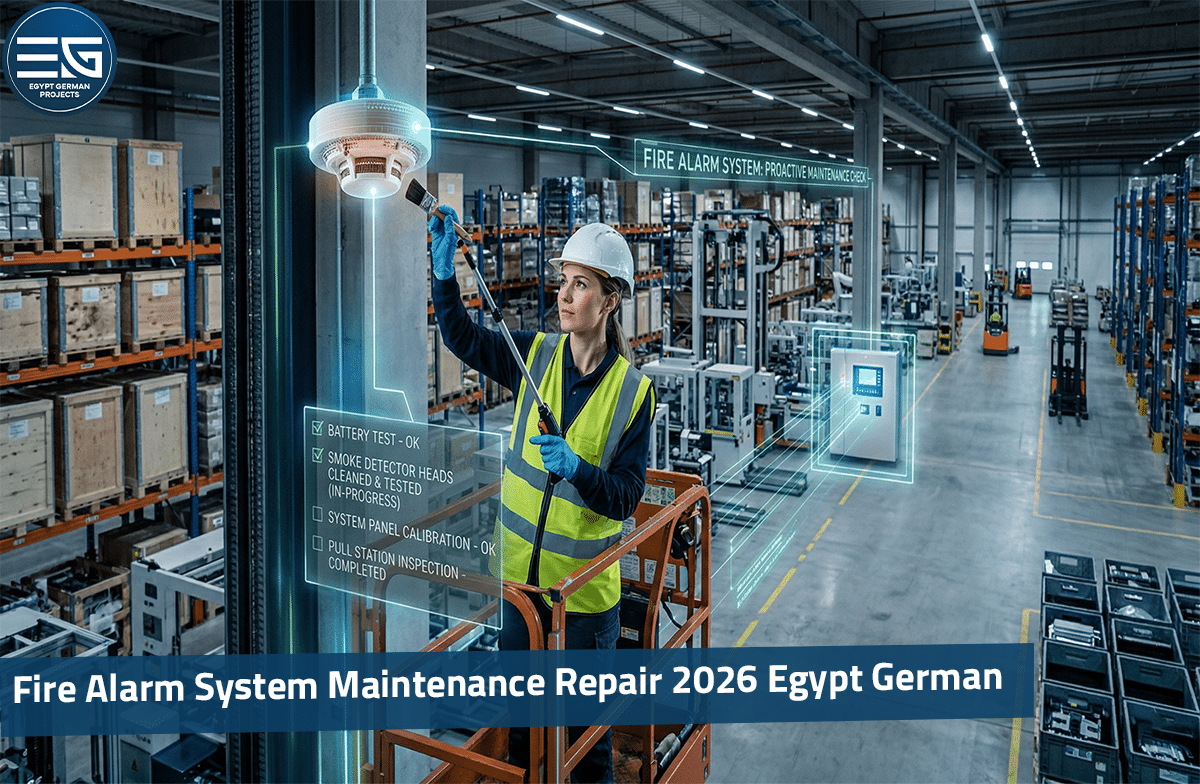
Industrial environments degrade safety equipment over time. For facility managers seeking reliable fire fighting maintenance in Egypt, our life-safety contracts provide ultimate risk mitigation. We execute rigid, calendar-based testing to ensure peak readiness year-round:
- Quarterly Pump Flow Testing: Verifying primary and jockey pumps engage instantly without seizing.
- Sprinkler & Valve Inspections: Clearing corrosion and ensuring no obstructions block water dispersion.
- Gas Cylinder Calibration: Precisely weighing CO2 and FM-200 tanks to guarantee exact pressure retention for electrical fires.
Secure Your Facility with Civil Defense-Compliant Fire Protection Systems?
Don’t leave your industrial assets or legal compliance to chance. Partner with a turnkey EPC contractor that engineers safety from the ground up. Contact Egypt German today to request a comprehensive site evaluation and a custom fire protection proposal.
Frequently Asked Questions for Fire Fighting Contractors in Egypt
What services do fire fighting companies in Egypt provide?
Full-service fire fighting companies provide complete Engineering, Procurement, and Construction (EPC) solutions. Their core services include hydraulic modeling, Egyptian Civil Defense (Code 305) blueprint approvals, hardware procurement, on-site installation, and long-term testing and maintenance. Top contractors also integrate these systems with Building Management Systems (BMS) and HVAC smoke control.
How long does Civil Defense approval take in Egypt?
Obtaining Civil Defense approval in Egypt typically takes 4 to 8 weeks, depending on the project’s scale. The timeline is split into two distinct execution phases:
- Engineering Design Approval (2 to 4 weeks): Review and certification of initial fire safety layouts and hydraulic schematics.
- Final Inspection & Licensing (2 to 4 weeks): On-site physical testing, walkthrough inspection, and system commissioning.
What NFPA standards apply to industrial fire fighting systems?
Industrial fire protection systems in Egypt must comply with international National Fire Protection Association (NFPA) frameworks. The primary standards include:
- NFPA 13: Standard for the Installation of Sprinkler Systems.
- NFPA 14: Standpipe and Hose Systems (matching regional hose reel mandates).
- NFPA 20: Standard for the Installation of Stationary Pumps.
- NFPA 11 & 16: Foam systems designed for petrochemical and fuel storage hazards.
- NFPA 2001: Clean Agent systems for data centers and server rooms.
How often should fire fighting systems be maintained?
To guarantee Civil Defense compliance and license renewals, fire networks require structured maintenance matching NFPA 25 protocols:
- Weekly: Visual inspection of water storage tank levels, pipeline pressures, and diesel pump fuel.
- Monthly/Quarterly: Testing of alarm notification devices, supervisory switches, and battery performance.
- Annually: Full hydraulic flow testing, fire pump curve analysis, and control valve trip-testing.
Which fire suppression system is best for electrical rooms?
The absolute best options for server rooms and electrical enclosures are gaseous clean agents like FM-200 (HFC-227ea) or CO2. These agents suppress fire rapidly at a molecular level without leaving any conductive or corrosive chemical residue. This protects multi-million pound IT infrastructure from suffering structural or water damage during discharge.
What are the fire protection requirements for warehouses in Egypt?
Under Egyptian Fire Code 305, industrial warehouses are legally required to install a layered defense system:
- Automated Sprinklers: An NFPA 13 wet-pipe system engineered for specific storage heights and commodity classes.
- Hose Reels & Hydrants: Internal hose networks distributed within a maximum spacing of 30 meters.
- Dedicated Water Reserves: On-site fire water tanks capable of delivering a minimum 2-hour continuous supply.
What is included in a turnkey fire fighting project?
A turnkey (EPC) fire protection project covers the entire lifecycle of a facility’s safety setup. It includes pre-construction hydraulic calculations, Civil Defense blueprint approvals, procurement of UL-listed/FM-approved hardware, pipeline installation, pressure testing, and the final handoff of the operating compliance certificate.
How are fire pumps selected for industrial facilities?
Industrial fire pumps are selected using precise hydraulic calculation modeling to determine required flow rates (GPM) and system pressure (PSI). To meet NFPA 20 compliance, standard industrial setups utilize a primary electric pump, an independent diesel backup pump, and a secondary auxiliary jockey pump to maintain uniform line pressure.